Many voices. One review before publishing.
Each person has their own Voice Profile and approves their own posts. You prepare, they add the final period, and there's a record of who approved which version.
Starts at one managed profile, whether it belongs to a client or to your team.
no Postin login neededThe work nobody bills for
Your margin goes on the work around the work.
Chasing, reminding, piecing things back together and explaining it all again: everything around each post.
- 01
Chasing approval
An email on Monday, a WhatsApp on Wednesday, an “I'll look at it this afternoon” that never comes. The post still isn't out, and it looks like your fault.
- 02
Not knowing which version was approved
The client said yes to one text, and you published another with a later fix. That's a conversation you can avoid.
- 03
Everyone sounding the same
When the same person writes for five clients, all five end up with the same tone. Their audiences notice before they do.
- 04
Starting from scratch every month
What you learned about a client lives in the head of whoever handles the account. If that person leaves, it leaves with them.
How it's organized
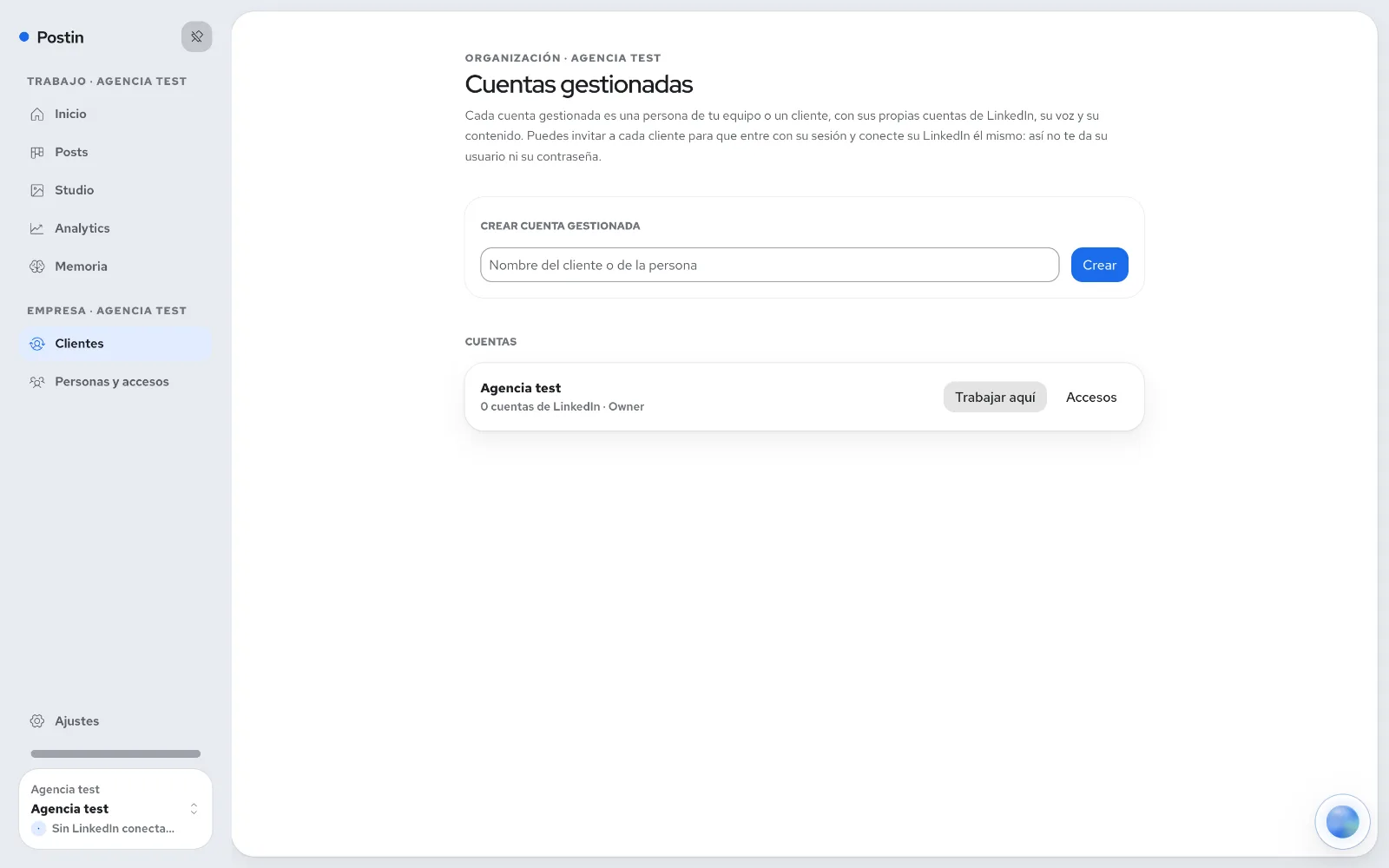
Your account, with one organization per client inside.
Each client is an organization, with its own people, voice and history. You get in with permissions, not with their credentials.
- 01
You add the client
You send them a link. They connect their LinkedIn through the official API, from their own session. You never see a password.
- 02
Their voice is created
From their own writing or a five-minute conversation. That voice belongs to their organization: it doesn't mix with any other client's.
- 03
Your team works inside
You invite whoever handles that client, with their role. What Postin learns about the client stays in its organization, even if the person handling it changes.
Approval
You know who approved, and which version.
The client gets the draft, reads it and approves it. If anyone touches the text afterwards, the approval no longer counts and is requested again. There's no way to publish something nobody approved.
- Every approval is tied to a specific version
- There's a record of who approved each version
- Publishing is always an explicit human action
Multi-account
Each client, their own organization.
Separate from the rest, with its own LinkedIn connection, voice, memory and history. You get in with permissions.
- Her LinkedIn, connected by her
- Her voice · her memory · her history
- Two people, two profiles
- A different voice for each
- Added by link, in a minute
- Starts empty: nothing inherited
Nothing mixes
One client's voice doesn't bleed into another's, and neither do their memory or sources.
Nothing is inherited
A new client starts from a blank slate. What Postin learns about them stays in their organization.
Nothing is lost
If the client leaves, they take their whole organization with them. You just lower your number of profiles.
Before and after
Your team prepares it. The final period is the client's.
These are client profiles, people outside your agency. Their part of the work is a single step, and there's a record of which version they approved.
- 1
The idea
Today
Every month, the same meeting to decide what each client is going to talk about.
With Postin
Postin
It suggests what to publish for each one. You give it a note and it does the research.
- 2
The draft
Today
The same person writes for five clients, and all five end up sounding the same.
With Postin
Postin
It writes the draft with that client's Voice Profile. No two voices get mixed.
- 3
The review
Today
A document, a chat and three versions. Nobody knows which one is final.
With Postin
Your team
Whoever handles the account edits it. The client never gets a raw draft.
- 4
The approval
Today
An email on Monday, a WhatsApp on Wednesday, an “I'll take a look” that never comes.
With Postin
The client
They approve from their link, without logging in to Postin or learning anything.
If the text changes, it comes back here. That's how you can prove what they approved.
- 5
Publishing
Today
You published the later fix, and the client says they approved something else.
With Postin
Postin
The approved version goes out, and there's a record of which one it was.
An approval is for one specific version
The client approves version 3. If someone touches it up, it becomes version 4 and you have to ask for their approval again. That way nobody publishes something the client didn't read.
Roles split the work
Your team writes, edits and schedules. Only the person whose name is on the post adds the final period. A role doesn't replace that person.
If the client would rather not log in to Postin, they can approve from the link they receive. What's not possible is publishing without their approval.
Who owns what
Your client's account is theirs.
It sounds like legal fine print, and it's a selling point: clients think twice about hiring an agency that asks for their LinkedIn password.
Their connection
They authorize it, through LinkedIn's official API, and can revoke it whenever they want.
Their voice and their content
Their Voice Profile, memory and history live in their organization. If they leave one day, all of it goes with them.
Your operation
You work through delegated permissions and see what you need to do the job. Their credentials stay theirs.
Agency or company
What if the profiles belong to your own people?
Then you're a company with many voices. Same plan and same price, and what you're buying is consistency between them.
Agency
The profiles belong to your clients
You prepare, they approve, and you pass the cost on as part of your service. What you're buying is serving more clients with the same team.
Company
The profiles belong to your team
Leadership, sales and product posting without sounding like the same press release, with the cost covered by the company.
You choose the account type when you create the account, and it can't be changed later.
What it costs
You pay per managed profile. The price drops as you grow.
It doesn't matter whether the profiles belong to your clients or your team: the scale is the same, and publishing isn't counted.
Profiles
3
Per month
€317
€106 per profile
You sign up on your own and add profiles whenever you like. Each person gets their own Voice Profile.
When you create the account, choose “Company or agency” and your number of profiles. The account type can't be changed later.
Create accountNo post limit
No quotas or counters on any profile you manage.
Add profiles whenever you like
You add profiles yourself, up to 10, and only pay for the days left in the month.
Yearly
Pay for ten months, use twelve.
What people always ask
Before you ask.
Do my clients have to learn another tool?
All they do is connect their account once and approve. If they'd rather not log in, you handle all the work, but the final approval is still theirs.
What if a client leaves?
They revoke their connection and keep their organization. You lower your number of profiles at the end of the billing cycle, after disconnecting them.
Can we put our own brand on it?
Not yet. White label is on the roadmap and has no date, so don't sell it as if it existed.
Can I start with just one client?
Yes. The plan starts at one managed profile, and you add more as new clients come in.
What happens if we stop paying?
The account becomes read-only until you're up to date: nothing is deleted and no one loses their content.
Does Postin publish anything without anyone seeing it?
No. That's the rule we never bend: it takes a human approval on a specific version.
Try it with your next client.
If approval is your bottleneck, this is a good fit.